- Home
- Users & Science
- Find a beamline
- Structural biology
- Our beamlines
- icOS - The in crystallo Optical Spectroscopy Laboratory
icOS - The in crystallo Optical Spectroscopy Laboratory
Overview
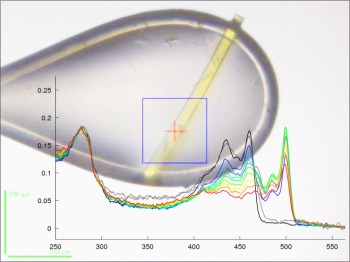
The icOS Lab (previously known as the Cryobench) is dedicated to various types of optical spectroscopy experiments on macromolecular crystals. The central device of the lab is a microspectrophotometer that allows to measure UV/vis absorption, fluorescence, or Raman spectra of protein crystals (or nanoliters of solutions). The lab is being run in the context of a close collaboration between the ESRF and the Institut de Biologie Structurale (IBS), and is one of the platforms of the Partnership for Structural Biology (PSB).
Publications
Click here for a list of Cryobench-related publications. Reference papers to be cited in your publications about Cryobench experiments are given here, as well as the Local Contact policy at the Cryobench.
Spectroscopic Methods
The Cryobench laboratory offers...
...of protein crystals mounted on a goniometer between three objectives, either cooled by a cryogenic stream or maintained at room temperature by a HC1 Humidity control device.
Additionally, it will soon be possible to perform spectroscopic experiments directly at X-ray beamlines:
- online UV/vis and fluorescence spectroscopy (on MASSIF-3 and FIP2),
- online Raman spectroscopy (on ID30B).
Suggestions for solving some frequent problems which you may encounter during your experiment can be found here.
Make sure that you know the safety regulations before coming to the Cryobench lab!
Equipment
Equipment which is available for such experiments includes:
- several computers,
- various lasers for fluorescence excitation or actinic purposes,
- different filters,
- a NIM board generating TTL pulses for controlling lasers and spectrometers,
- some additional equipment which is not actively maintained at the moment.
For most pieces of equipment, manuals or datasheets are available (intranet only).
Beamtime applications
Click here to find out how to apply for experiments at the Cryobench lab.
partners


European Synchrotron Radiation Facility - 71, avenue des Martyrs, CS 40220, 38043 Grenoble Cedex 9, France.