- Home
- Users & Science
- Scientific Documentation
- ESRF Highlights
- ESRF Highlights 2005
- X-ray Absorption and Magnetic Scattering
- X-ray Detected Magnetic Resonance at a K-edge: First Evidence of Forced Precession of Polarised Orbital Components
X-ray Detected Magnetic Resonance at a K-edge: First Evidence of Forced Precession of Polarised Orbital Components
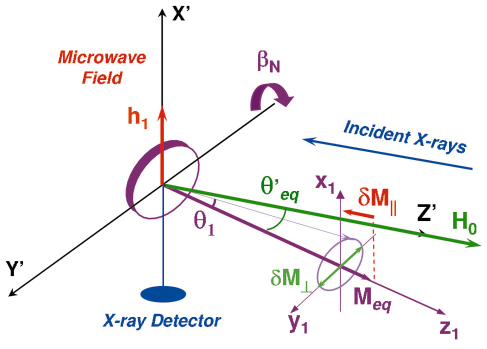
X-ray Detected Magnetic Resonance (XDMR) is a novel spectroscopic method in which X-ray Magnetic Circular Dichroism (XMCD) is used to probe the resonant precession of the magnetisation caused by a strong microwave pump field h1 orthogonal to the static bias field H0. For the first time, XDMR was measured on exciting the Fe K-edge in a high quality thin film of Yttrium Iron Garnet (YIG: 8.9 µm thick) grown by liquid phase epitaxy along the (111) direction of a Gadolinium Gallium Garnet (GGG) substrate [1]. This experiment carried out on beamline ID12 was performed in the longitudinal geometry (see Figure 117), i.e. the wavevector kx(||) of the incident, circularly-polarised X-rays being parallel to the static bias field H0. The XDMR signal recorded in the X-ray fluorescence excitation mode was then proportional to the microwave power that was amplitude modulated at Fm = 35.5042 kHz. To minimize radiation damping effects, the microwave frequency (9445.0 MHz) was slightly offset with respect to the resonance of the overcoupled rectangular TE102 X-band cavity. Given the narrow FMR linewidth of the YIG film:  Hfwhm (ßN = 30°) = 3.64 Oe, there is no doubt that, with an incident microwave power of 30 dBm, resonant pumping occurred in a non-linear foldover regime [2] characterised by a critical precession angle which was estimated to be ca.
  crit = 6.8° under the conditions of the XDMR experiment.
 |
|
Fig. 117: XDMR in longitudinal geometry. |
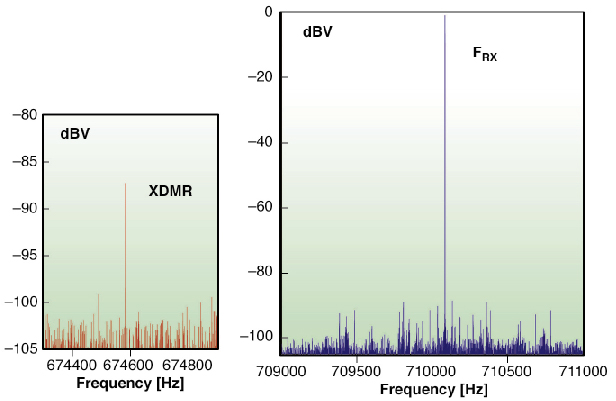
The resonance field was precisely scanned down to the onset of the critical foldover jump found at H0 = 3980.6 Oe whereas the energy of the incident X-rays was tuned to 7113.74 eV, i.e. to the maximum of the XMCD signal in the pre-peak of the XANES spectrum. Since the ESRF storage ring was run in the 2*1/3 filling mode, the incident X-rays were modulated at the macrobunch repetition frequency FRX = 710.084 kHz. The XDMR signal displayed in Figure 118 is one of the modulation side-bands expected at 710.084 ± 35.5042 kHz whereas the signal at FRX was used only for data renormalisation. The magnitude of the XDMR signal is peaking ca. 20 dBV above the noise floor. The real and imaginary parts of the spectrum confirmed the expected inversion of the XDMR signal when the helicity of the incident X-ray beam was changed from left to right. After proper renormalisation, the small differential cross-section:  XDMR ~ 1.34·10-5 would yield a critical precession angle of 10 ~ 3.5° for the moments precessing at the Fe sites.
 |
|
Fig. 118: XDMR signal as low-frequency side-band of FRX. |
Since the effective operator accounting for XMCD at the Fe K-edge can be written [3]: ∂/∂E [<Lz>4P +  <Lz>3d], the measured Fe K-edge XDMR signal thus produces clear evidence of the forced precession of orbital polarisation components.
Let us emphasise that the precession angle 10 deduced from XDMR for these orbital components is only one half of the critical precession angle crit of the effective spin moment. Since the electron gyromagnetic ratios for orbital and spin moments are precisely in a 1:2 ratio, our XDMR result proves that, in YIG, there is no dynamical quenching of the magnetic orbital polarisation components: spin-orbit coupling dominates orbit-lattice interactions in Kittel’s picture of FMR.
References
[1] J. Goulon, A. Rogalev, F. Wilhelm, N. Jaoen, C. Goulon-Ginet, G. Goujon, J. Ben Youssef and M.V. Indenbom, JETP Letters, 82, 791-796 (2005).
[2] A.G. Gurevich and G.A. Melkov: Magnetization Oscillations and Waves, CRC Press Boca Raton, Inc. (1996).
[3] H. Ebert, V. Popescu and D. Ahlers, Phys. Rev. B 60, 7156 (1999).
Principal publication and Authors
J. Goulon (a), A. Rogalev (a), F. Wilhelm (a), N. Jaouen (a), C. Goulon-Ginet (a), G. Goujon (a), J. Ben Youssef (b), M.V. Indenbom (b) JETP Letters, 82, 791-796 (2005).
(a) ESRF
(b) Laboratoire de Magnètisme de Bretagne, CNRS FRE 2697, UFR Sciences et Techniques, Brest (France)
partners


European Synchrotron Radiation Facility - 71, avenue des Martyrs, CS 40220, 38043 Grenoble Cedex 9, France.