- Home
- Users & Science
- Scientific Documentation
- ESRF Highlights
- ESRF Highlights 2004
- X-ray Absorption and Magnetic Scattering
- Oscillatory Magnetic Behaviour in One-Dimensional Atomic Wires
Oscillatory Magnetic Behaviour in One-Dimensional Atomic Wires
Fundamental research on magnetic thin films has greatly advanced our understanding of magnetism, unveiling unknown phenomena and contributing to the rapid development of data storage devices and magnetic sensors. A prominent issue in this context is to understand how symmetry and composition effects determine the orientation and magnetisation reversal properties of nanostructured materials. Extensive work on two-dimensional (2D) magnetic layers has shown that a lowering of the symmetry compared to bulk systems results in enhanced magnetocrystalline anisotropy energy (MAE), the property that describes the tendency of the magnetisation to align along specific spatial directions in a crystal [1]. Likewise, magnetic anisotropy effects have been predicted to be particularly strong in 1D metal chains, where changes in the symmetry and atomic coordination produce strong modifications of the electronic band structure compared to 2D systems [2]. Experiments on beamline ID08 addressed these issues for the first time in 1D metal chains of thickness controlled down to the monatomic limit, revealing a rich and unexpected magnetic behaviour.
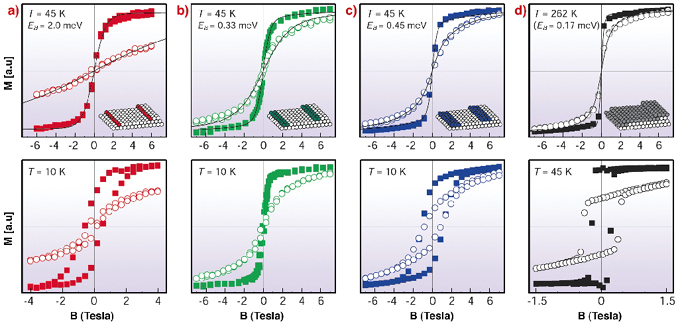
X-ray magnetic circular dichroism (XMCD) measurements probed the magnetism of Co chains deposited along the step edges of a vicinal Pt(111) surface [3]. Figure 119 shows the magnetisation curves for single, double, and triple atomic chains as well as for 1 Co monolayer (coverage equivalent to 8 atomic chains) recorded by monitoring the maximum of the XMCD signal at fixed photon energy (L3 edge, 779 eV) as a function of the applied magnetic field. A fit of the magnetisation measured parallel to the easy and hard axes in the superparamagnetic regime (upper panels) reveals a very large MAE, Ea = 2 meV per Co atom, for the monatomic chains, which is one order of magnitude larger than typical values in 2D films [1]. Even more surprisingly, the MAE first decreases and then increases again in the double and triple chains, respectively, contrary to the expected monotonic decrease with increasing coordination of the Co atoms. Such strong MAE changes are mirrored by the hysteretic behaviour of the magnetisation at low temperature (lower panels) and by fluctuations of the coercive field (not shown). A previous study showed that long-range ferromagnetism in 1D systems can exist as a metastable state stabilised by strong MAE barriers [3]. Here, ferromagnetic behaviour is shown to vanish going from single to double Co chains as a consequence of the reduced MAE (Figures 119a and b, bottom panels).
 |
|
Fig. 119: Magnetisation of (a) single Co chains, (b) double chains, (c) triple chains, (d) 1.3 monolayers in the easy (filled squares) and hard direction (empty circles). The solid lines are fits to the data in the superparamagnetic regime. |
XMCD measurements also allowed the tracking of the easy direction of magnetisation as a function of the Co chain thickness. Figure 120 shows the L3 XMCD signal measured in the plane perpendicular to the chain axis by varying the angle  between the surface normal and the photon beam direction. The sinusoidal behaviour indicates a predominant uniaxial character of the magnetic anisotropy for the chains and monolayer samples, with the maximum of the |cos()| function corresponding to the easy direction of magnetisation. As minimal variations of the Co coverage result in strong dimensionality changes in this system, the magnetisation turns out to be extremely sensitive to the chain transverse structure. The easy axis reverses abruptly from = +46° (step up direction) for the single chains to -60° (step down) for the double chains, and reverses back towards the surface normal in the monolayer regime. This rotation of the easy axis corresponds to a sign inversion of the MAE, in addition to the magnitude oscillations discussed above. As energy considerations exclude dipolar interactions as a cause for the magnetisation rotation, such MAE oscillatory behaviour is attributed to the 1D character of the chains and related changes of the electronic configuration with increasing number of atomic rows. Electronic structure calculations for both free-standing and supported Co chains substantiate this finding[2].
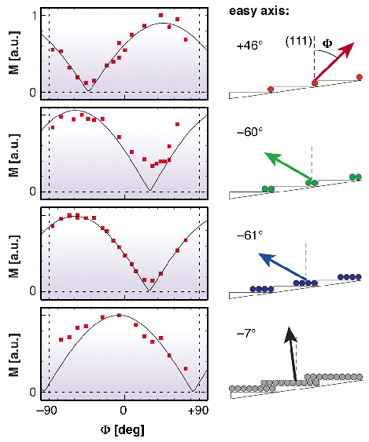 |
Fig. 120: Near remanence Co chain magnetisation, M, measured in the plane perpendicular to the wire axis at an angle |
In conclusion, reducing the dimensions of a 2D magnetic layer down to 1D atomic chains reveals a strikingly rich magnetic behaviour connected to the chain thickness and specific electronic configuration. In particular, the easy axis of magnetisation, the magnetic anisotropy energy, and the coercive field display strong oscillations going from monatomic chains to double and triple chains, and to a monolayer film.
References
[1] U. Gradmann, in Handbook of Magnetic Materials Vol. 7., edited by K.H.J. Buschow (Elsevier, Amsterdam 1993).
[2] J. Dorantes-Dávila and G.M. Pastor, Phys. Rev. Lett. 81, 208 (1998).
[3] P. Gambardella et al., Nature 416, 301 (2002).
Principal Publications and Authors
P. Gambardella (a), A. Dallmeyer (b), K. Maiti (b), M.C. Malagoli (b), S. Rusponi (a), P. Ohresser (c), W. Eberhardt (b), C. Carbone(b,d), and K. Kern (a,e), Phys. Rev. Lett. 93, 077203 (2004).
(a) EPF Lausanne (Switzerland)
(b) FZ Jülich (Germany)
(c) ESRF
(d) CNR-ISM, Trieste (Italy)
(e) MPI Stuttgart (Germany)
partners


European Synchrotron Radiation Facility - 71, avenue des Martyrs, CS 40220, 38043 Grenoble Cedex 9, France.