- Home
- Users & Science
- Scientific Documentation
- ESRF Highlights
- ESRF Highlights 2000
- Surfaces and Interfaces
- The NiO(111)-p(2x2) Surface
The NiO(111)-p(2x2) Surface
Since the bulk structure of the electrostatically polar (111) surfaces of the rock-salt oxides has alternating cationic and anionic sheets along the [111] direction, the simple truncated surfaces must have a divergent electrostatic energy, in theory making them highly unstable. Thus, until recently, the polar rock-salt surfaces were believed to be unstable and a mysterious class of surfaces. However, their technological importance is growing because of their interesting magnetic properties. In particular, the (111) plane of NiO may perform exchange coupling for ferromagnetic films of the newest giant magnetoresistive sensors. Only recently [1] it was predicted that such surfaces may be stabilised by a particular p(2x2) "octopolar" reconstruction (Figure 54), which cancels the divergence of the electric field in the crystal.
 |
Fig. 54: Top (a) and side (b) views of two possible octopolar reconstructions with Ni- or O-terminated terraces (left and right respectively), separated by a single step (solid line). Large circles are oxygen atoms, and small circles are nickel. For either termination, the top two layers are 75% and 25% vacant compared to the bulk lattice. The possible symmetry-compatible relaxations,
 and and  , are shown as arrows indicating a positive relaxation. , are shown as arrows indicating a positive relaxation. |
We have undertaken a series of grazing incidence X-ray diffraction experiments on beamlines ID3, ID32 and BM32 to determine the actual structure and preparation conditions of NiO(111) on both single crystals and thin NiO(111) films. All experiments were performed under ultra high-vacuum conditions (UHV) at high photon energy (17-18 keV).
For that purpose, a preparation procedure leading to crystals of high perfection was developed [2]. In the vacuum chamber after the last air annealing, the surfaces of the Ni crystal was found to be p(2x2) reconstructed with mosaicity parallel to the surface of 0.05-0.02° and typical in-plane domain sizes between 1000 and 1800 Å. The NiO(111) thin film was prepared in situ on Au(111). The 5 monolayer-thick film showed good epitaxy, good crystalline quality, was completely relaxed and p(2x2) reconstructed with 0.106° in-plane mosaicity, 550 Å domain size producing intense reflections throughout the accessible region of reciprocal space.
In-plane structure factors of the p(2x2) reconstruction were measured quantitatively for all accessible reflections belonging to the reconstruction. For the single crystal, 138 structure factors were recorded. Reproducing all the data (global  2 = 1.5, Figure 55) restricted the solution to the Ni-terminated octopolar reconstruction uniquely with the small atomic relaxations indicated in Figure 54. For the thin film, the octopolar reconstruction was unable to reproduce the 32 non equivalent in-plane structure factors, regardless of the relaxations. The out-of-plane periodicity, seen in 13 diffraction rods with 322 non-zero structure factors, indicates a 3 layer thick reconstruction. Only a coherent juxtaposition, with small relaxation, of half Ni- and half O-terminated domains separated by single-steps is in agreement with the experimental data (provided that the bases of the two octopoles have the same orientation, Figure 54) with a global 2 = 1.4 (Figure 55). Other models containing the two terminations over bulk-like layers are also able to reproduce the data, but they appeared unacceptable with respect to the growth process.
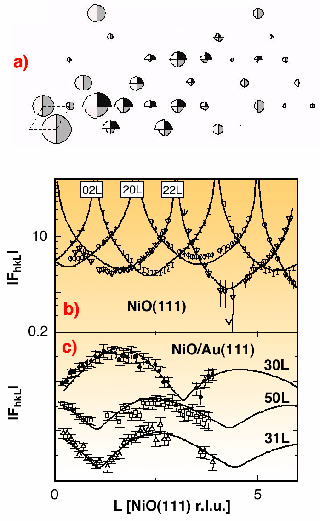 |
Fig. 55: (a) Comparison between the measured in-plane structure factors (right) and calculated ones (left) for the octopolar reconstruction of the air-annealed single crystal with Ni apex (top when the reflection was measured) and the thin film compared to the two-domain octopolar reconstruction (bottom and complete circles). (b) Measured 20L (o), 22L (
 ) and 02L ( ) and 02L (  ) NiO(111) crystal truncation rods compared with a relaxed Ni terminated octopolar reconstruction (straight lines); (c) Comparison of measured and calculated diffraction rods of the p(2x2) reconstruction of a 5ML thick NiO(111) film grown on Au(111). The h and k indexes are expressed in the (2x2) reciprocal surface lattice units. ) NiO(111) crystal truncation rods compared with a relaxed Ni terminated octopolar reconstruction (straight lines); (c) Comparison of measured and calculated diffraction rods of the p(2x2) reconstruction of a 5ML thick NiO(111) film grown on Au(111). The h and k indexes are expressed in the (2x2) reciprocal surface lattice units. |
Annealing the single crystal in UHV leads to decomposition [2]. Under up to 10-4 mbar O2 the annealing drastically transforms the internal structure of the reconstruction leaving a spinel like reduced O-terminated surface [3].
From these studies it has become clear that the reconstruction mechanism proposed to stabilize polar rock-salt surfaces is correct but with a more complex surface chemistry than expected. A general instability due to the polarity can thus be ruled out.
References
[1] D. Wolf, Phys. Rev. Lett. 68, 3315 (1992).
[2] A. Barbier and G. Renaud, Surf. Sci. Lett. 392, L15 (1997).
[3] A. Barbier, C. Mocuta and G. Renaud, Phys. Rev. B 62, 16056-16062 (2000).
Principal Publication and Authors
A. Barbier (a), C. Mocuta (a), H. Kuhlenbeck (b), K.F. Peters (c), B. Richter (b) and G. Renaud (a), Phys. Rev. Lett. 84 (13), 2897-2900 (2000).
(a) CEA/Grenoble (France)
(b) Fritz-Haber-Institut der Max-Plack-Gesellschaft, Berlin (Germany)
(c) ESRF
partners


European Synchrotron Radiation Facility - 71, avenue des Martyrs, CS 40220, 38043 Grenoble Cedex 9, France.