- Home
- Users & Science
- Scientific Documentation
- ESRF Highlights
- ESRF Highlights 2003
- X-ray Absorption and Magnetic Scattering
- Icosahedral Ordering in Liquid and Undercooled Metals
Icosahedral Ordering in Liquid and Undercooled Metals
Local ordering in liquid condensed phases can show signatures of five-fold symmetry that are forbidden in crystals. Current experimental knowledge of liquids is limited to the pair distribution, leaving considerable uncertainty in the determination of the local geometrical structure. The presence of this particular type of local symmetry can be studied by taking advantage of experimental techniques such as X-ray absorption spectroscopy (XAS) which is sensitive to local higher-order correlations through multiple-scattering of the photoexcited electron from a core level.
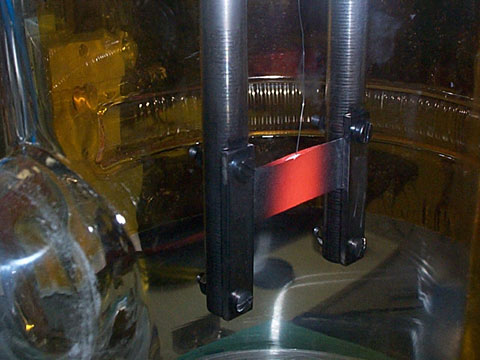
Accurate experiments on liquid and undercooled liquid Cu have been performed at the ESRF, exploiting the potential of BM29 [1] for combined XAS and X-ray diffraction measurements under extreme conditions. We have applied a new Reverse Monte Carlo (RMC) multiple-scattering data-analysis method incorporating all of the advances included in our original XAS MS data-analysis program (GNXAS [2]). The samples were pellets constituted by dispersions of submicrometric Cu grains into a graphite matrix suitable for high-temperature measurements (see Figure 107). The sample can be easily undercooled down to 100 K below the melting point as already observed for other metals and semiconductors.
 |
|
Fig. 107: Cu pellet at high temperature inside the graphite crucible of the L'Aquila-Camerino XAS-XRD oven available at BM29. |
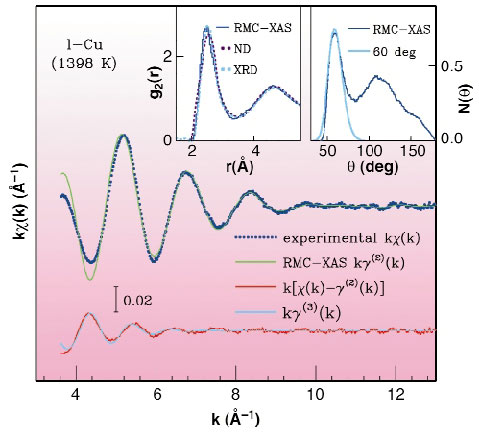
The XAS structural signal of liquid Cu measured at 1398 K (l-Cu) is compared with the two-body component of the RMC multiple-scattering simulation in Figure 108. The RMC simulation has been performed in a 864-atom cubic box of fixed density, while considering both the XAS experimental data and the published g(r) curve obtained by neutron diffraction (ND). The RMC curve reproduces almost exactly the shape of the ND and XRD g(r) at long distances while the first-neighbour peak, determined with very high accuracy, is narrower and shifted to shorter distances. The high-frequency oscillation of the residual curve (red) shows that the simple two-body  (2) contribution is not able to reproduce the experimental curve and that higher-order terms have to be included in the simulation.
 |
|
Fig. 108: XAS experimental data of liquid Cu compared with the results of a RMC multiple-scattering simulation. |
In a monoatomic close-packed liquid, the most commonly occurring local three-body configuration is expected to be an equilateral triangle formed by first neighbours. The difference spectrum (lower curve in Figure 108) is compared with a XAS three-body signal calculated using a Gaussian three-body distribution for equilateral triangles. In fact, the main component of the XAS three-body signal is associated with the peak of the bond-angle N( ) distribution associated with nearly-equilateral triangular configurations, as shown in the upper-right inset of Figure 108.
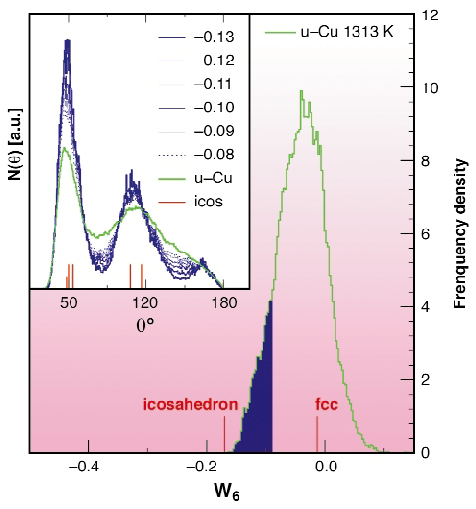
A geometrical analysis of our final RMC atomic configurations has been carried out in terms of the W6 spherical harmonics invariant (Figure 109). The W6 distribution of the liquid is found to be very broad and strongly asymmetric towards negative values extending down to the ideal value for a perfect icosahedral cluster. The N() (see left inset in Figure 109) corresponding to W6 values very near to the icosahedral limit shows a distinct peak at 60° and a second peak around 110° with a clear minimum at 90°, similar to the ideal case shown by red ticks in the inset. A suitable upper limit (W6 = -0.09) corresponds to a broadening of about 10 degrees around the ideal icosahedron values and can be taken as a reasonable borderline for evaluating the fraction of nearly-icosahedral configurations (around 10%).
 |
|
Fig. 109: Histogram of the frequency density of the W6 invariant monitoring the local geometry around each atom in liquid Cu. The bond-angle distribution related to selected regions of the W6 distribution is shown in the inset. |
In conclusion, novel X-ray absorption experimental results on liquid and undercooled liquid copper, interpreted using an advanced data-analysis method based on multiple-scattering simulations are shown to contain direct information on triplet correlations making feasible a reliable determination of the bond-angle distribution and fraction of icosahedral configurations in liquids. A detailed statistical analysis of local geometry in liquid Cu shows that a significative although limited fraction (10%) of local atomic configurations has a clear five-fold symmetry.
References
[1] A. Filipponi, V.M. Giordano, S. De Panfilis, A. Di Cicco, E. Principi, A. Trapananti, M. Borowski, and J. P. Itie', Rev. Sci. Instr. 74, 2654-2663 (2003).
[2] A. Filipponi, A. Di Cicco and C.R. Natoli, Phys. Rev. B 52, 15122 (1995).
Principal Publication and Authors
A. Di Cicco (a), A. Trapananti (a), S. Faggioni (a), and A. Filipponi (b), Phys. Rev. Lett. 91, 135505 (2003).
(a) INFM, Universita' Di Camerino (Italy)
(b) INFM, Universita' dell'Aquila (Italy)
partners


European Synchrotron Radiation Facility - 71, avenue des Martyrs, CS 40220, 38043 Grenoble Cedex 9, France.