- Home
- Users & Science
- Support and Infrastructure
- X-ray Optics
- Crystal Polishing laboratory
Crystal Polishing laboratory
The Crystal Polishing laboratory provides advice, support, research and development in the field of crystal X-ray optics.
It also manufactures and characterises single-crystal X-ray optics for ESRF beamlines and external customers.
The Crystal Polishing laboratory manufactures perfect crystal monochromators for all ESRF beamlines. Most crystals are made from 100mm diameter, high-purity silicon float-zone ingots of up to 1m long that are manufactured industrially. For the production of monochromators these ingots must be transformed into objects of various size and shape depending on the final application.
 |
Monochromators come in a great variety, ranging from simple rectangular plates to complex Bragg-Laue crystals and nested channel-cut devices for high spectral and angular resolution. |
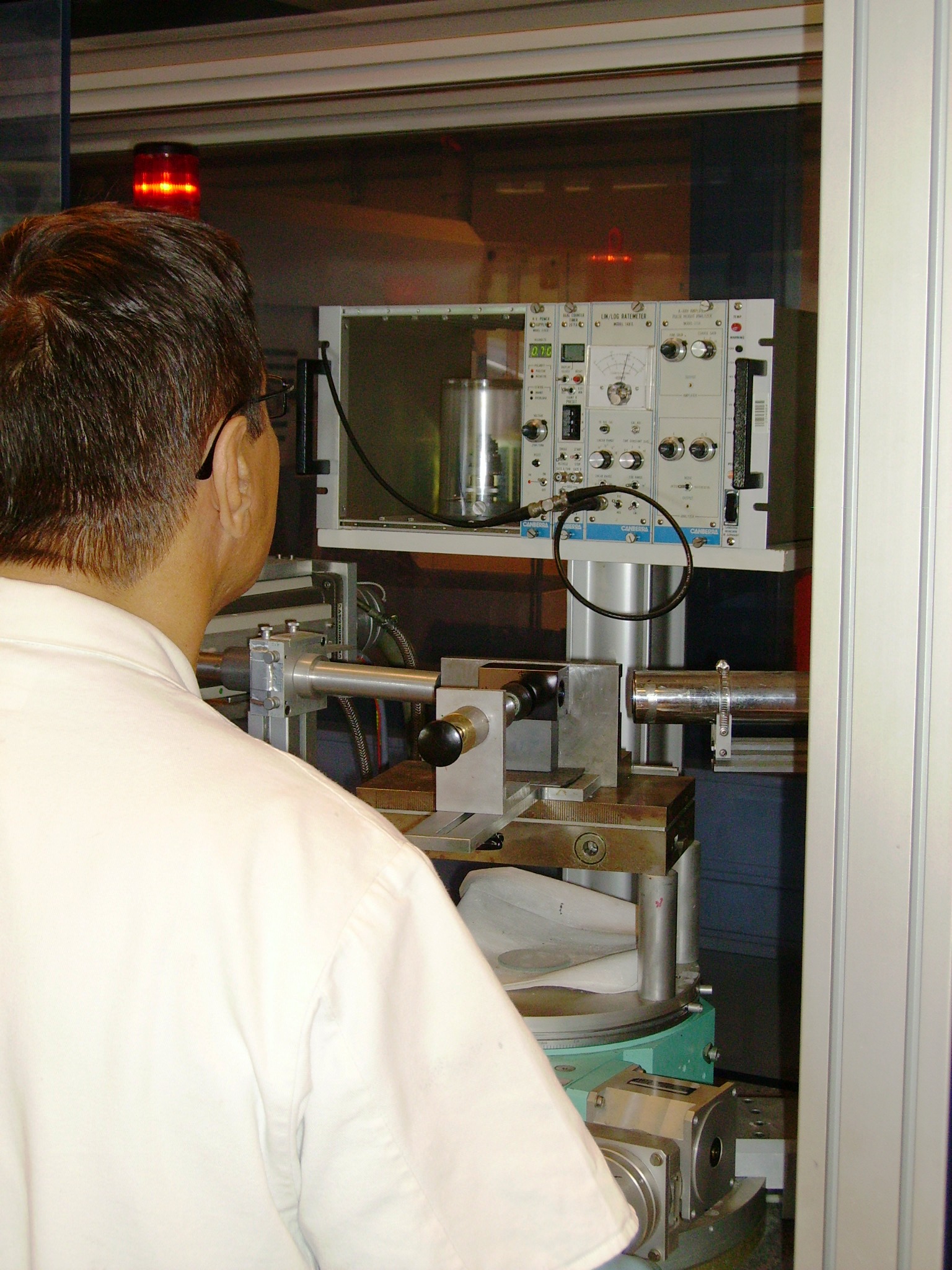 |
Preparing the crystals: the raw ingots are oriented on an X-ray single crystal diffractometer. |
Preparation of the crystals requires several steps:
- The raw ingots must be oriented. This is performed on an X-ray single crystal diffractometer. Based on this measurement a flat surface is ground roughly parallel to the required crystallographic lattice planes.
- Then the crystal is held against a flat vertical surface serving as a reference in the centre of the two circle diffractometer. The beam (CuKα1-radiation) emitted horizontally by a sealed X-ray tube is transmitted through a window in the centre of the reference plate, diffracted by the crystal and received by the detector set at twice the Bragg angle when Bragg's condition is fulfilled.
- The crystal is turned about an axis normal to its surface. If the Bragg peak remains constant, the surface is parallel to the lattice planes. If not, the miscut angle can be measured using the diffractometer and the surface orientation is corrected by grinding. After one or several iterations the right orientation is obtained. An accuracy of 1/1000 degree can be obtained, but usually 1/100 degree is requested.
- Once two perpendicular faces of the ingot have been prepared, the crystal is glued on a glass plate with a mixture of beeswax and collophane that is glued on a steel plate. The whole is clamped on the magnetic base of the support in a circular diamond saw. Four degrees of freedom (three high-precision translations and one rotation) are available and simple shapes can be produced with this saw (fig. 3). The longest cut is 500 mm; the deepest 120 mm. A milling machine, that can be equpped with different diamond tools, is used to generate more complicated shapes. Holes (for cooling purposes) are obtained with a special core-drilling machine.
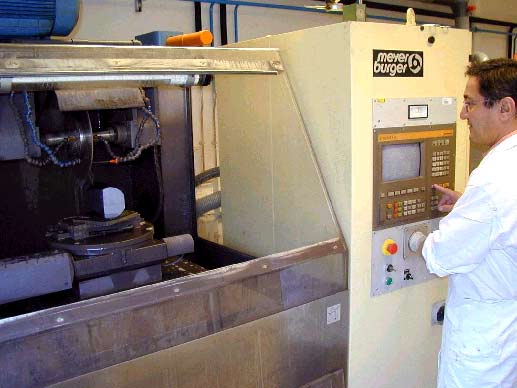 |
Circular diamond saw |
Subsequent processing consists of fine grinding and lapping of the surfaces exposed to the X-ray beam, either using grinding wheels or by hand (e.g. inside channel-cut crystals), followed by chemical etching to remove the surface damage (fig. 4). According to specifications, the surface can be polished. This is necessary for applications that require minimal perturbation of the X-ray wavefront, e.g. imaging techniques where surface structure must be avoided. Chemo-mechanical polishing (CMP) is generally the final step following polishing of the etched surface using very fine diamond powder. The best surface finish presently obtained is about 1Å (rms) while the best figure (flatness) for a thick specimen is around 1 µrad (rms).
About one ton of silicon single crystal material has been processed and many different types of flat or bent, also directly cooled objects have been produced. X-ray crystal optics, like beamline concepts, constantly evolve following the general evolution of instrumentation for synchrotron X-rays to meet new scientific goals.
Critical issues are precise, strain-free mounting and bonding of the crystals on supports for cooling and bending. Here the traditional art and skill of handcrafting meet with the modern tools of mechanical and thermal engineering such as finite element analysis. A critical ingredient for the production of high performance crystal optics is the detailed understanding of the diffraction processes in perfect, curved or otherwise deformed crystals that allow us to predict their effect on X-ray beam propagation and on the final performance of optical schemes.
partners


European Synchrotron Radiation Facility - 71, avenue des Martyrs, CS 40220, 38043 Grenoble Cedex 9, France.